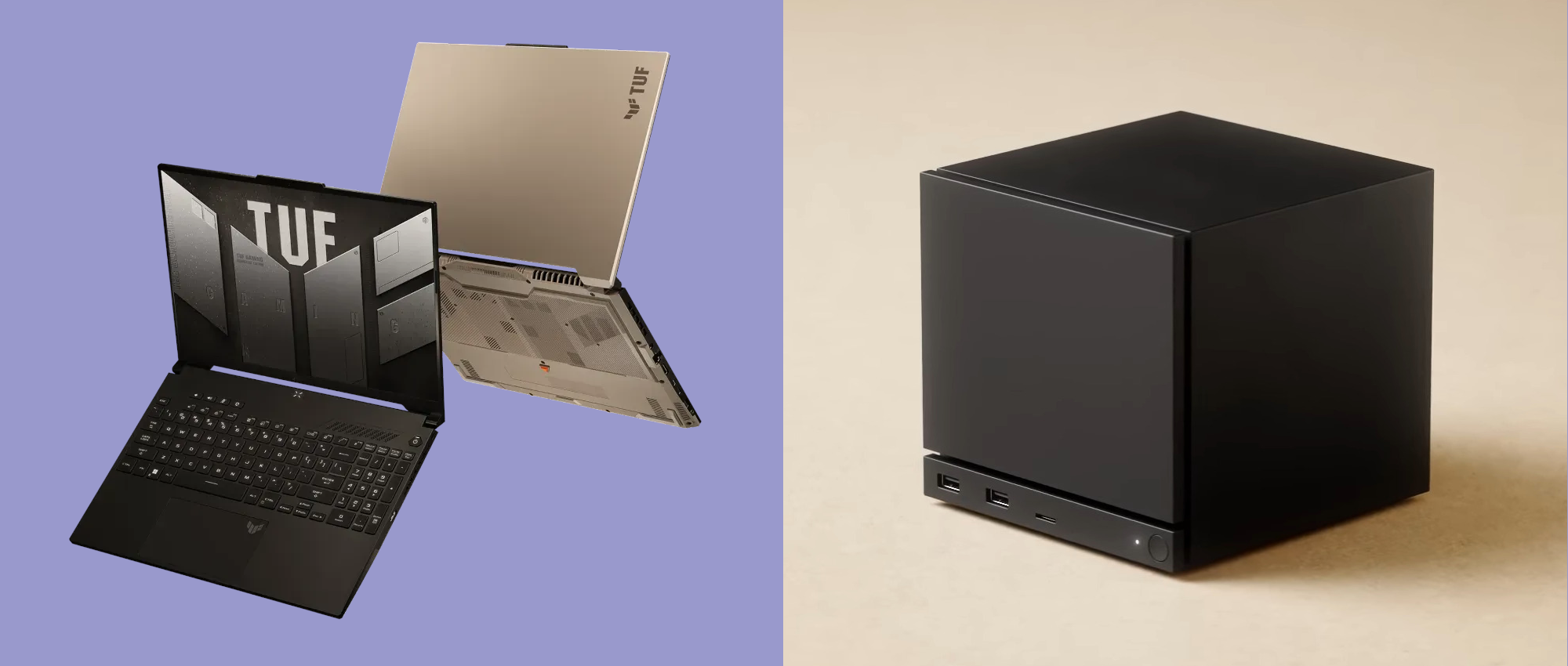
Introduction
When Valve published the hardware specifications of the Steam Machine last year, I believed my Asus Tuf A16 laptop would be competitive in performance because of similarity in hardware components on paper. Valve has sent production units to various media outlets and the reviews are out. I have benchmarked my Asus Tuf A16 and collected the results. We now can compare the numbers.
Setup
Here is a quick overview of hardware specs and software setup for each devices.
| Asus Tuf A16 | Steam Machine | |
| OS | Debian 13 Trixie | SteamOS 3.8 |
| Kernel | 7.1 (via backports) | 6.16 |
| CPU | AMD Ryzen 7735HS Zen 3+ 8 cores / 16 threads up to 4.7 GHz 35W TDP | semi-custom Zen 4 6 cores / 12 threads up to 4.8 GHz 30W TDP |
| RAM | 16GB 8GB DDR5-4800 x 2 | 16GB 16GB DDR-5600 x 1 |
| GPU | AMD Radeon RX 7700S RDNA 3 32 compute units up to 2500 MHz 120W TDP | semi-custom RDNA 3 28 compute units up to 2450 MHz 110W TDP |
Debian 13 is shipped with Linux kernel 6.12 but I have upgraded it to 7.1 on my Asus Tuf A16 via backports (Debian testing packages for next release recompiled to be used in current stable release) for fun.
Benchmarks
| Asus Tuf A16 | Steam Machine (source) | A16 Relative Performance to Steam Machine | |
| Geekbench 6 single-core / multi-core | 2130 / 9922 | 2579 / 8680 (Tom’s Hardware) | 83% / 114% |
| 7-Zip Compression | 74045 MIPS | 55126.5 MIPS (GamersNexus) | 134% |
| 7-Zip Decompression | 102656 MIPS | 67437.0 MIPS (GamersNexus) | 152% |
| GravityMark 500,000 Asteroids | 13479 | 13617 (Tom’s Hardware) | 99% |
| Superposition 1080p Extreme | 5469 | 5311 (Tom’s Hardware) | 103% |
| Cyberpunk 2077 1080p Preset: Ultra | 84.41 fps | 58.5 fps (GamersNexus) | 144% |
| Cyberpunk 2077 1080p Preset: High | 99.80 fps | 79.98 fps (Tom’s Hardware) | 125% |
| Cyberpunk 2077 1080p Preset: Steam Deck | 124.10 fps | 97 fps (Tom’s Hardware) | 128% |
| Cyberpunk 2077 1080p Preset: Ray Tracing Ultra | 27 fps | 15 fps (Tom’s Hardware) | 180% |
| Shadow of the Tomb Raider 1080p Preset: High | 132 fps | 129 fps (Rock Paper Shotgun) | 102% |
Tom’s Hardware review of Steam Machine can be found here.
GamersNexus review of Steam Machine can be found here.
Rock Paper Shotgun review of Steam Machine can be found here.
I ran each benchmark multiple times on the Asus Tuf A16 and selected the median value from each data set (the value in the middle, where one half of values are larger and other half smaller) for comparison. Screen captures of the median values from the A16 are shown below.
Asus Tuf A16 Benchmarks Screen Captures


Final Thoughts
Going in, I thought the two devices would be close in performance and trade blows depending on the types of workloads because both devices share similar components. On CPU side, both devices use mobile Zen CPU. A16 is half generation behind (Zen 3+ vs Steam Machine’s Zen 4) but has 2 more cores (4 more threads) plus 5W power advantage. On RAM side, both use DDR5 memory. Steam Machine has higher speed (5600 MT/s vs A16’s 4800 MT/s) but only 1 stick (single channel vs A16’s dual channel). On GPU side, both adopt RDNA 3 mobile GPUs. A16 has 4 more compute units plus 10W power advantage. Other than CPU generation and RAM speed, A16 holds minor advantages in all other hardware specifications. Therefore I kind of expected A16 to beat Steam Machine by small margins in most benchmarks.
The A16 won all benchmarks except two, Geekbench 6 single-thread and GravityMark. I totally expected the single-thread result because of Steam Machine’s CPU generation advantage. They were close in some benchmarks: GravityMark, Super Position, and Shadow of the Tomb Raider. A16’s margins of victory were -1%, 3%, and 2% respectively. However, I was surprised by A16’s margins of victory in 7-Zip and Cyberpunk 2077 which ranged from 25% to 80%. Some can be attributed to Steam Machine’s strict power limitations to keep the whole device cool and quiet. The same can not be said for A16 which operates like a jet engine. Perhaps the single memory stick setup in Steam Machine can be really detrimental in performance for certain workloads.
The price of Steam Machine reflects the sad state of PC gaming (and PC building as well) in 2026, where AI data centers demands have inflated the price of RAM, GPU, and SSD/HDD for consumers. It is also part of disturbing trend where gaming are becoming unaffordable to average folks. At $1049 for base model, Steam Machine is really just for Valve fans with deep pockets and a bad value proposition for everyone else considering its lackluster performance.
However, not all is bad with the Steam Machine release. The device helps promote Linux gaming and Windows-to-Linux migration. Valve has really made gaming on Linux easy through Steam. If you can install and run Steam on your Linux distribution, you should have no problem playing many Windows games. Valve has also incorporated feature like FSR 4.1 (AMD’s latest up-scaling and frame generation technology) in a beta version of Proton (its custom version of WINE, a compatibility layer capable for running Windows application on OS such as Linux, macOS and BSD). Average users can just let Steam client take care of various software integrations behind the scene.
I do not believe any year is the year of Linux desktop, even with Windows 11’s flaws and Microsoft missteps. Just because I made the Windws-to-Linux migration without any major hiccups does not mean others can nor will. Everyone’s use case is different. There are still too many issues with Linux desktops. There are also too many Linux desktop options. However, WINE/Proton and Steam in Big Picture mode can make things very interesting for Linux on market share.
This was an interesting exercise for me. I learned quite a few benchmark tools for Linux and I will run many of them again for my present and future Linux setups. You may not need a Steam Machine. If you have a PC with half decent video card that is only a few years old, you may already have a Steam Machine that is more powerful than the actual Steam Machine. Valve stills wins as long as you run Steam.