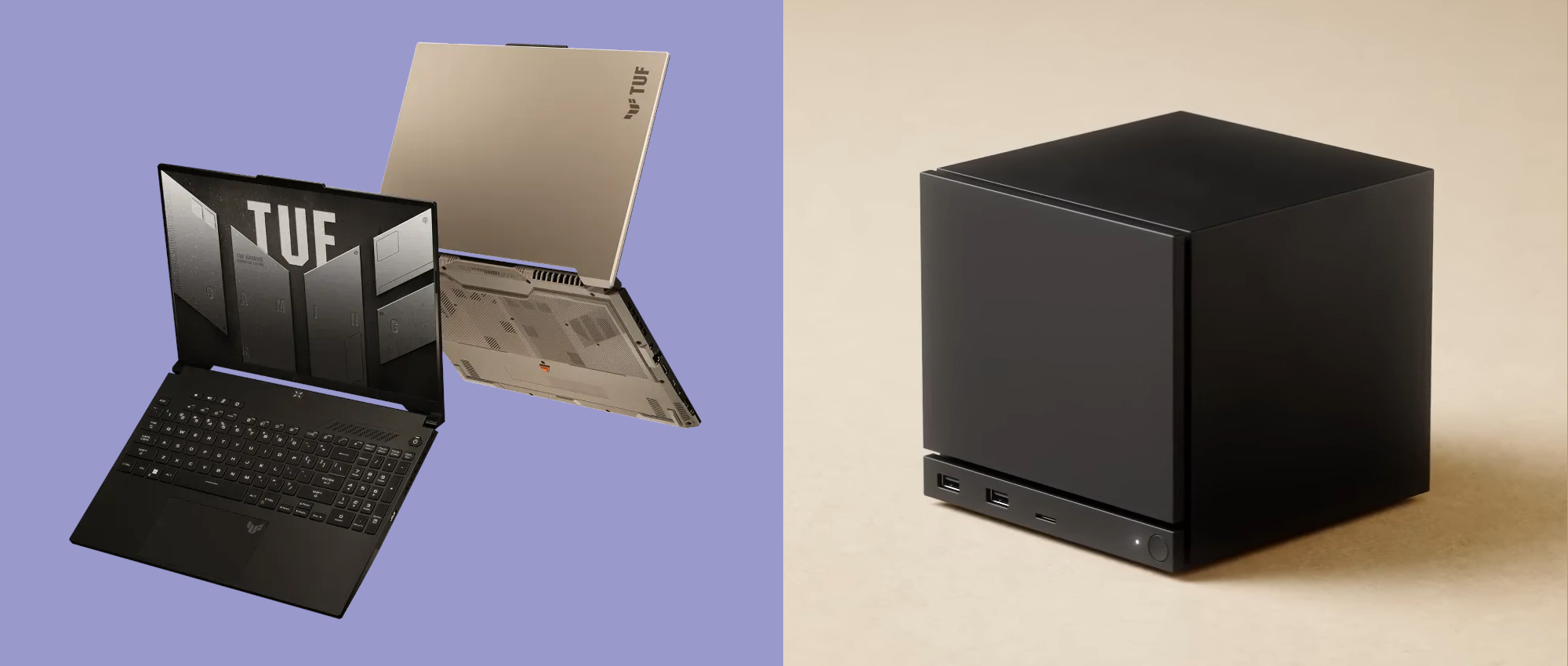
A Product Announcement
When Valve announced new Steam Machine for 2026, a.k.a. GabeCube, its published specifications did not directly identify the AMD CPU and GPU, just some background information on those parts. Tech review resources like Digital Foundry and TechPowerUp have made educated guesses on equivalent AMD components out on the market. Based on their conjectures, I recognize that my Asus Tuf A16 (Advantage Edition 2023 FA617NT) is fairly comparable to the Steam Machine.
Comparison
| My Asus Tuf A16 (FA617NT) | Steam Machine | |
| Form Factor | laptop | desktop cube |
| Release Year | 2023 | 2026 |
| Price | $700 (Oct 2024) | ? |
| CPU | AMD Ryzen 7735HS | ? |
| CPU Architecture | Zen 3+ | Zen 4 |
| CPU Cores/Threads | 8/16 | 6/12 |
| CPU Boost Clock | Up to 4.7 GHz | Up to 4.8 GHz |
| CPU Power | 35 W TDP | 30 W TDP |
| RAM | 16 GB DDR5 | 16 GB DDR5 |
| RAM Speed | 4800 | ? |
| GPU | AMD Radeon RX 7700S | ? |
| GPU Architecture | AMD RDNA 3 | AMD RDNA 3 |
| GPU Compute Units | 32 | 28 |
| GPU Clock | 1500 MHz | 1720 MHz |
| GPU Boost Clock | Up to 2500 MHz | Up to 2450 MHz |
| GPU Power | 120 W TDP | 110 W TDP |
| GPU Memory | 8 GB GDDR6 | 8 GB GDDR6 |
| GPU Memory Clock | 2250 MHz | 2250 MHz |
| HDMI | 2.0 | 2.0 |
| WiFi | 6 | 6E |
| Bluetooth | 5.3 | 5.3 |
| OS | Debian 13 Trixie | SteamOS 3 (Arch-based) |
| Desktop | Gnome | KDE Plasma |
The data in the table above came from the following sites: Valve, Asus, and TechPowerUp.
My Thoughts So Far
Steam Machine GPU should perform like a Radeon RX 7600M is the general consensus. If that is the case, A16’s Radeon RX 7700S has about 6% edge in gaming benchmarks according to NotebookCheck. There is a lack of attention on Steam Machine CPU understandably but Ryzen 7640U looks like a good match on paper according to some. If that prognosis holds, Steam Machine CPU has about 9% edge over A16’s Ryzen 7735HS in benchmarks according to NotebookCheck. That lead can get bigger if Steam Machine has faster RAM. A16’s RAM speed of 4800 is mediocre. Those benchmarks were conducted in Windows but I expect similar performance gap in Linux. The two devices are trading blows, hypothetically speaking.
A16’s HDMI port is capable of supporting HDMI 2.1 according to the laptop’s technical specification but not in Linux. Steam Machine is in the same boat. AMD could not get HDMI Forum to approve its HDMI 2.1 open-source driver for Linux. Linux users of Radeon GPUs are advised to use DisplayPort for features like 4K@120Hz and 5K@240Hz. This is something I learned while writing this blog.
Steam Machine is obviously not for me. I agree with the opinion that its CPU is good enough but its GPU is questionable. I can also build a more powerful Steam Machine myself. It would be much more interesting for me if the GPU is on par with Radeon RX 9060 XT with 16 GB of VRAM. I recognize that Valve is trying to make Steam Machine affordable but it may still be expensive no matter what just because the markets for PC parts are out of whack.
While SteamOS as a Linux distro is very interesting, I doubt I will install it on any of my PCs, unless it offers major performance advantage over other Linux distros in gaming. I prefer a general-purpose operating system that can play games over a gaming-focus operating system. I can run Steam in Big Picture Mode on Debian 13 and that feature works just fine.
Final Thoughts for Now
Who is Steam Machine for? I think it is for PC gamers who are looking for console-like experience, do not find existing gaming PCs out on the market appealing, and do not want to build one themselves. They also have to not mind that several popular first-person shooters will not work and settle for lower graphic settings in some other games. Some first-person shooters with anti-cheat do not work in Linux, including SteamOS. You can buy Steam Machine and replace SteamOS with Windows so you can play those first-person shooters. If you do that, you will have to deal with all the negative issues running Windows, especially 11. When you factor in the price, how big is the audience? I hope it is not just Valve/Steam fans with money to burn.
Steam Machine is going to compete against Sony’s PS5 and PS5 Pro despite of Valve’s message saying that it is a PC, not a console. I also think Steam Machine’s success or failure will have little impact on Valve’s dominance in PC gaming either way. That is why the company is unwilling to subsidize the hardware. I paid $700 for the A16 in October of 2024. Some think the Steam Machine will be released at that price early 2026. PC components usually become less expensive over time, but not these days. This is becoming a dark time for consumers on PCs and their components. Thanks AI.
I still look forward to Valve dropping Steam Machine on the market early next year. If Valve and AMD have some software magic tricks to get more out of a RDNA 3 GPU, my A16 will enjoy the benefit as well down the road. I also look forward to benchmarks and run some of them myself on the A16 to see the actual performance gaps between the two devices.
My Steam Machine price prediction: $649 512GB model, $799 2TB model. Just a hunch.
This post was composed on Asus Tuf A16. No AI tools were used.